RXNT Named to TIME World's Top HealthTech Companies of 2026 for Second Consecutive Year

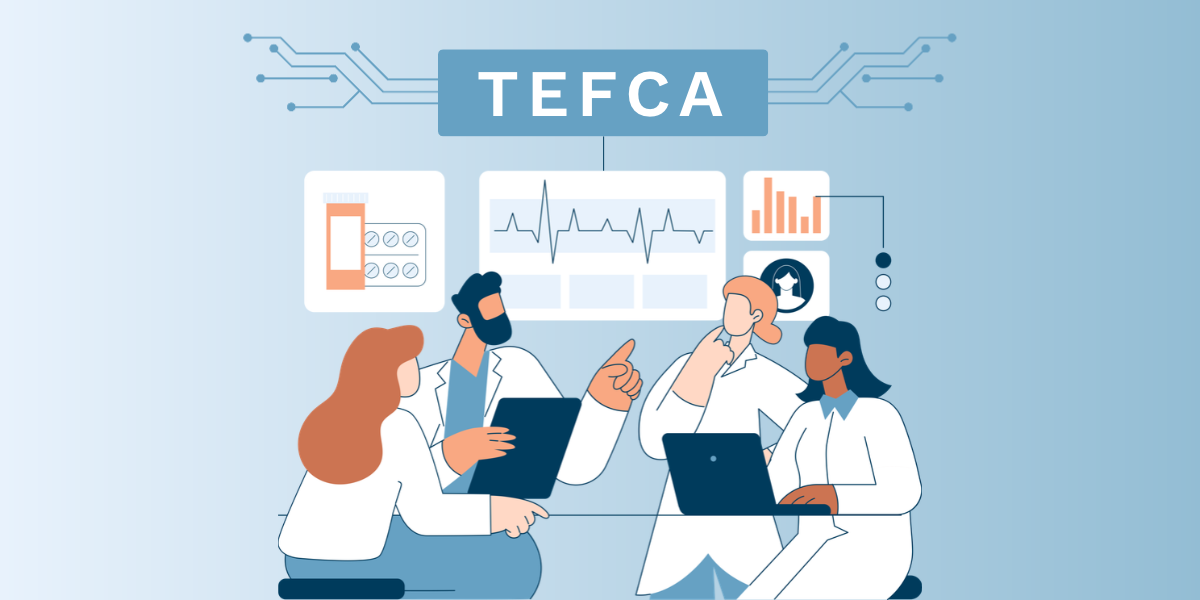
TEFCA establishes a common framework for securely exchanging electronic health information across different networks. By connecting through a QHIN, participating organizations can exchange information with other organizations connected to other QHINs without building separate connections to every network. The benefits of TEFCA include broader access to patient information, better care coordination, reduced manual record retrieval, and greater value from electronic health record (EHR) technology—creating a better care experience overall.
Key takeaways
- TEFCA creates a nationwide framework for exchanging electronic health information.
- Participating organizations connect directly or indirectly through a designated QHIN.
- Broader record access supports faster, better-informed clinical decisions.
- Integrated connectivity can reduce the use of faxing, phone calls, and manual record requests.
- Practices should ask EHR vendors how TEFCA access works, what data is available, and whether additional costs apply.
Imagine you’re traveling for your summer vacation and end up with excruciating stomach pain. You decide to schedule a same-day appointment with a local urgent care. Besides concerns over your vacation being cut short, you may also worry about how this team will treat you without information about your medical history, medications, and past test results on hand. The good news? The local urgent care team can securely locate and access your health information without having to call or fax your provider. This is all thanks to the Trusted Exchange Framework and Common Agreement, commonly known as TEFCA. The urgent care team has a more complete picture of you as a patient and can get you feeling better faster.
What Is TEFCA?
TEFCA is a public-private initiative created to establish a universal floor or baseline for health information exchange across the United States. It provides common legal, governance, security, and technical requirements that participating health information networks follow. After going live in December 2023, TEFCA has continued to expand through designated Qualified Health Information Networks (QHINs).
The purpose of the framework is to help providers, health plans, public health agencies, and patients securely access electronic health information, regardless of where that information is stored.
An important aspect of TEFCA is QHINs. QHINs complete a formal designation process to act as connection points for nationwide exchange. This allows healthcare organizations and technology vendors to connect and exchange information with organizations using other QHINs, and practices and EHR vendors don’t have to establish individual agreements with countless networks.
The Value of TEFCA Connectivity
| Benefit | What It Means for Healthcare Practices | Potential Impact |
|---|---|---|
| Faster Access to Patient Records | Authorized providers can access relevant information from participating organizations nationwide. | Less time searching for records and more time evaluating and treating patients. |
| Better Care Coordination | Nationwide exchange can give providers a more complete view of care delivered by other practices, facilities, laboratories, pharmacies, and specialists. | Fewer duplicated tests, safer medication decisions, and smoother transitions between care settings. |
| Reduced Administrative Burdens | EHR-integrated connectivity can reduce reliance on phone calls, authorization forms, follow-ups, scanning, and faxed records. | More efficient workflows and easier access to outside information without repeatedly leaving the EHR or navigating disconnected systems. |
| Preparation for Future Interoperability Requirements | TEFCA continues to evolve through updated technical documents, procedures, exchange purposes, and capabilities. | Technology that supports nationwide exchange can help practices adapt to future expectations and advancements. |
| Greater Long-Term Value From the EHR | TEFCA connectivity can make the EHR part of a broader nationwide exchange ecosystem rather than a system that only stores information created within one practice. | Providers may gain a more complete view of the patient. |
Key Questions to Ask Your EHR Vendor About TEFCA
Before selecting an EHR system, ask the vendor:
- Is your EHR connected to a designated QHIN?
- Which QHIN do you connect through?
- Is TEFCA connectivity available now, or is it still on your product roadmap?
- What types of clinical information can users locate, retrieve, and exchange?
- How is outside information matched to the correct patient?
- Can providers access records within their normal EHR workflow?
- Can information be incorporated into the patient chart, or is it view-only?
- What training, onboarding, or configuration is required?
- Are there additional implementation, subscription, or transaction costs?
- How will your platform support new TEFCA capabilities and interoperability standards?
Ideally, you’ll receive specific answers to each question rather than a simple statement that their platform is “interoperable.” These answers should help you understand what is available, how it works, and what the experience will be for providers and staff.
Getting Your Practice Ready for Nationwide Health Information Exchange
TEFCA has moved into active nationwide exchange. As participation grows, practices should evaluate whether their technology can connect them to the broader healthcare ecosystem.
RXNT recently announced TEFCA connectivity and integrated QHIN access through a strategic partnership with Kno2. Kno2 is a designated QHIN, and the integration is designed to give our customers access to expanded health information exchange capabilities within their existing technology workflows.