RXNT Named to TIME World's Top HealthTech Companies of 2026 for Second Consecutive Year

The Trusted Exchange Framework and Common Agreement (TEFCA) and the network of Qualified Health Information Networks (QHINs) it established represent the most significant shift in health information exchange in decades. This guide explains what QHINs are, how the exchange framework works, and how practices can get real, practical value from QHIN connectivity.
Key takeaways
- QHINs are the backbone of nationwide health information exchange under TEFCA, enabling practices to access complete patient records across organizations and systems in real time.
- QHIN access supports better care coordination, reduces duplicate testing, and improves transitions of care by giving providers a more complete picture of each patient at the point of care.
- Practices that establish QHIN connectivity now will be better positioned for the interoperability requirements and value-based care expectations already shaping the future of healthcare.
- RXNT has established TEFCA connectivity and integrated QHIN access through a strategic partnership with Kno2, making nationwide interoperability accessible directly within the RXNT platform. This feature is being gradually rolled out to more RXNT users.
For years, healthcare interoperability meant phone calls, fax machines, and hoping that records from another organization arrived before the patient did. The information existed; getting it into the right hands at the right time was the problem. TEFCA and the QHIN framework are designed to change that in a meaningful and lasting way.
What Is a QHIN?
A Qualified Health Information Network, or QHIN, is a designated organization that serves as a node in the nationwide health information exchange infrastructure established under TEFCA. QHINs are the connective tissue of that infrastructure, enabling health information to move securely between providers, health systems, payers, and other participants across the country.
To become a QHIN, an organization must complete a rigorous onboarding process and meet the governance, technical, and security requirements established under TEFCA. As of now, only seven organizations have completed that process and are recognized as designated QHINs: CommonWell Health Alliance, eHealth Exchange, Epic Nexus, Health Gorilla, Kno2, KONZA National Network, and MedAllies. Each of these QHINs connects directly to the others, which is what makes truly nationwide interoperability possible under a single governance framework.
How TEFCA Connects Practices to a Nationwide Network of Health Information
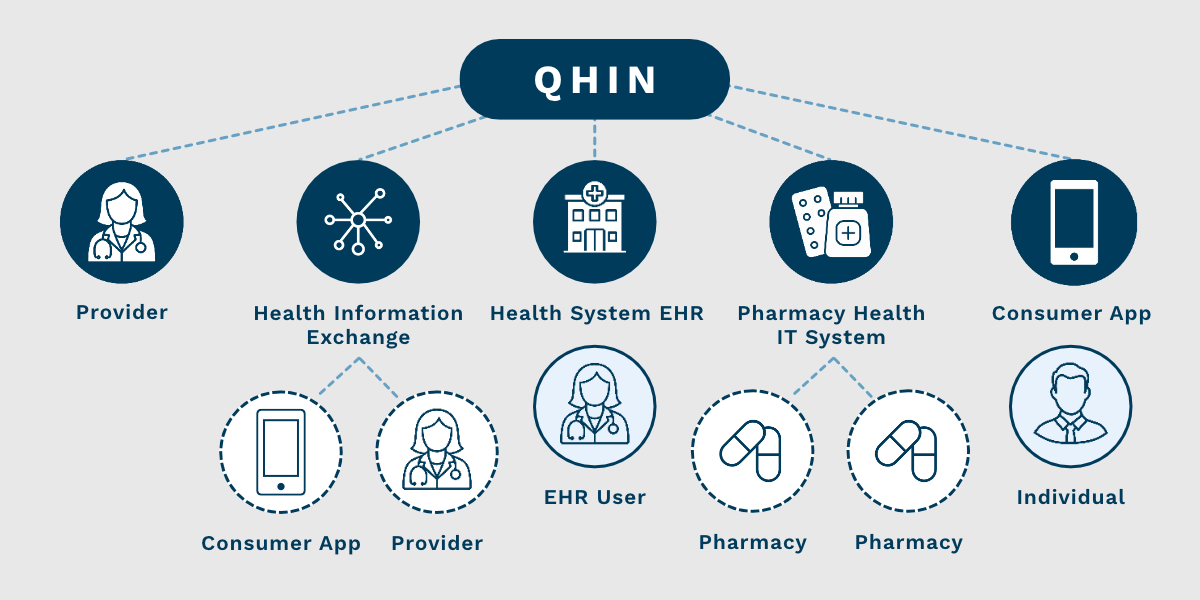
The TEFCA framework operates through a defined hierarchy. ONC defines the overall policy framework and governance requirements. The Recognized Coordinating Entity (RCE) provides oversight for the QHIN layer, ensuring designated QHINs operate consistently and in compliance with TEFCA requirements. The seven designated QHINs connect directly to each other, enabling a provider in one region to access patient records held by a health system anywhere in the country.
Each QHIN connects to Participants, which are organizations such as health systems and health IT vendors that join the network through a QHIN. Participants connect Subparticipants, which include individual practices and clinics that access the network through a Participant relationship. In practical terms, a practice doesn’t need to establish direct connections with every other organization in the network. Connecting through a QHIN via a Participant relationship provides access to the entire nationwide exchange infrastructure. RXNT’s TEFCA connectivity and integrated QHIN access through its strategic partnership with Kno2 brings this capability directly into the RXNT platform, removing the technical barriers that have historically made nationwide interoperability difficult for independent and mid-size practices.
The Benefits of QHIN Access That Go Beyond Regulatory Compliance
Beyond governance and regulatory requirements, businesses have incentives to care about QHIN. QHIN access delivers benefits across clinical care and practice operations, such as:
More complete patient records at the point of care
QHIN connectivity makes it possible to query external records before or during a visit, giving providers a more complete clinical picture without manual outreach or delays.
Reduced duplicate tests and procedures
When providers can see what has been ordered at another organization, they can make better decisions about what actually needs to be done, reducing cost for the practice and the patient.
Better care coordination
Patients with complex conditions often see multiple providers across different organizations. QHIN connectivity supports the information sharing that makes coordinated care possible and reduces the gaps that occur when each provider is working from an incomplete picture.
Improved transitions of care and referral management
When the receiving provider has access to the referring provider’s records through QHIN exchange, transitions are smoother, safer, and less dependent on manual processes.
Support for value-based care
Value-based care models require a comprehensive view of patient health across the care continuum. QHIN access supports the data sharing that makes population health management and care gap identification more accurate and actionable.
Getting the Most Value From QHIN Connectivity
Having QHIN access and using it effectively are two different things. Here is how practices can put QHIN connectivity to work to deliver real operational and clinical value.
Use external records before patient visits
Querying available external records ahead of scheduled appointments gives providers context that would otherwise require manual outreach, improving visit quality and reducing time spent reconstructing clinical history during the encounter.
Improve referral workflows
QHIN connectivity makes it easier to share relevant clinical records when sending a referral and query the sending provider’s records when receiving one. Both directions of the referral workflow become more efficient and less dependent on faxes.
Reduce administrative burden
A significant share of administrative work in a typical practice involves chasing records and manually reconciling information from multiple sources. QHIN access makes record retrieval a query-based process rather than a manual outreach process, and that time savings compounds across a busy practice.
Prepare for future interoperability requirements
Practices that establish QHIN connectivity now are building the infrastructure and workflows future regulations will require, rather than scrambling to comply when those requirements take effect.
Frequently Asked Questions
What is the difference between a QHIN and a traditional health information exchange?
A traditional HIE typically operates at a regional or state level. A QHIN connects to other QHINs nationwide under TEFCA, giving practices access to records from organizations across the entire country.
Does a practice need to connect directly with a QHIN?
No. Practices typically access the TEFCA exchange as a Subparticipant through a Participant organization such as a health IT vendor. RXNT’s partnership with Kno2 provides this access directly within the platform.
Is QHIN access only relevant for large health systems?
Not at all. Platform-level partnerships like RXNT’s integration with Kno2 make nationwide interoperability accessible to independent and mid-size practices without requiring dedicated IT resources or separate vendor relationships.