RXNT Named to TIME World's Top HealthTech Companies of 2026 for Second Consecutive Year
Traditional EHRs do a great job of storing data—but what they sometimes lack is the ability to surface insights in a simple, digestible way that makes providers’ jobs easier.
It’s a familiar feeling for healthcare providers: opening a patient chart and being greeted by pages of notes, test results, medication lists, and diagnosis histories that stretch back years. Weren’t electronic health records (EHRs) designed to centralize this information? In reality, they can sometimes overwhelm rather than enlighten.
Traditional EHRs do a great job of storing data—but what they sometimes lack is the ability to surface insights in a simple, digestible way that makes providers’ jobs easier. They may fail to intelligently highlight the pieces of information that providers need most in the moment of care, and that gap between information and insight creates three common challenges:
- Time pressure: Physicians spend approximately 36 minutes on EHR work per patient visit.
- Cognitive overload: With so much raw information presented in long lists and scattered notes, it becomes harder to extract what matters.
- Patient safety risks: Errors, duplications, or inconsistencies in the record may go unnoticed. This can lead to inappropriate prescribing or missed diagnoses.
The more time providers spend wrestling with EHRs, the less time they can spend with the patient sitting in front of them. Ultimately, storing information isn’t enough. What providers really need is a system that transforms data into clarity at the point of care.
Providers Need a Better Way to Gain Insights
Today’s healthcare providers need speed and accuracy. A single visit can involve reviewing years of history, updating current medications, assessing allergies, and confirming recent test results. This all may occur before meaningful face-to-face time begins. That doesn’t even mention the pressures of high patient volumes, documentation requirements, and billing compliance. It all leads providers with little bandwidth to manually sort through disorganized charts.
What’s missing here is a way to transform raw records into structured, reliable insights. That’s where artificial intelligence can make a real difference.
Introducing RXNT’s AI Encounter Insights
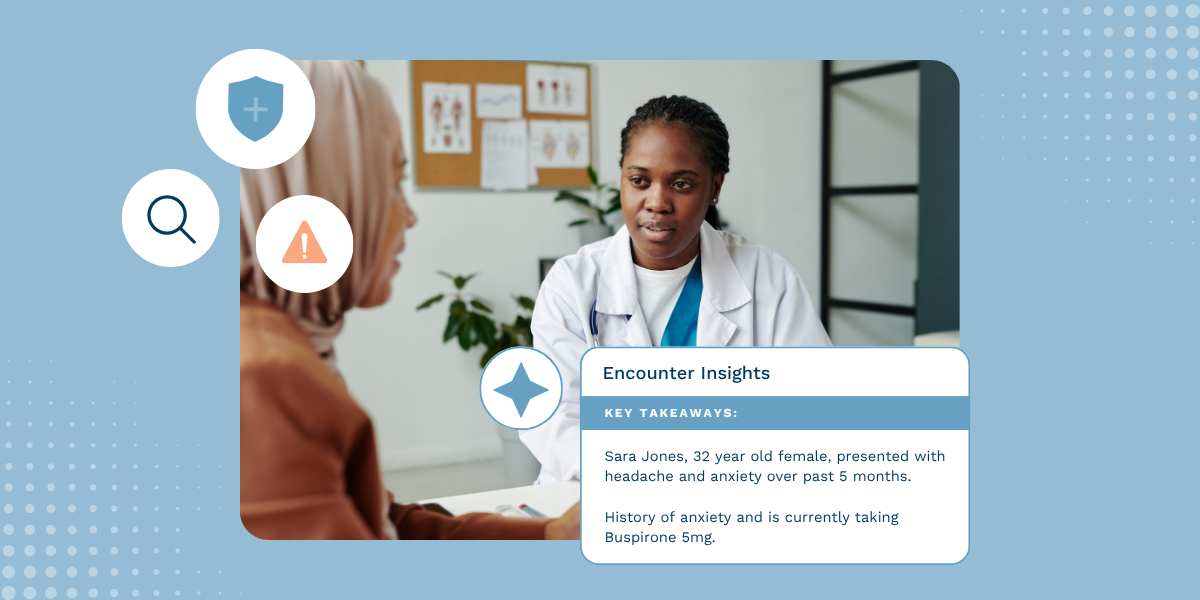
To close this gap, RXNT developed AI Encounter Insights. This feature is designed to help providers quickly understand a patient’s encounter history without the burden of lengthy, manual review. Rather than expecting providers to dig through every note and entry, the system uses AI to generate a summary of each past encounter.
What does this look like in practice? A provider can open AI Encounter Insights and immediately see the essentials without going through dozens of pages of data. Rather than opening each encounter and reading through an entire document, they can get a quick understanding of past encounters and whether their documentation contains info relevant to the current visit. When more detail is needed, they can then review individual documents and charts with more depth.
All of this is made even easier thanks to Encounter Insights’ search feature, which makes each encounter summary searchable. Using relevant keywords, providers can quickly identify past visits where specific topics were discussed, diagnoses made, etc., freeing up critical time in preparation for and during patient visits.
Catching Discrepancies Before They Become Risks
Beyond summaries, RXNT’s AI Encounter Insights actively flags potential errors and inconsistencies. If a piece of information appears twice in the notes of a single encounter but with conflicting values, a warning about the potential error will appear. For example, these errors may be a patient’s BMI being listed at two different values, or a prescription described at two different doses. These embedded safety features reduce the risk of flawed information remaining in the chart.
Other benefits include:
Improved Patient Safety
- AI Encounter Insights reduces the risk of prescribing errors or missed contraindications.
- Providers can make treatment decisions knowing that they’ve reviewed a clean, accurate summary of past encounters.
Streamlined Workflows
- Chart reviews that once required 15 minutes can now be completed in a fraction of the time. This translates to more patient-facing time or lighter overall workloads.
Reduced Administrative Burden
- Providers can enjoy a reduced mental load and less stress, helping to prevent burnout.
Enhanced Patient Experience
- Patients appreciate that their provider is focused and attentive, rather than being buried in a laptop or tablet.
- Increased face-to-face interaction builds trust and strengthens the provider-patient relationship.
Putting AI Into Practice
AI Encounter Insights is built directly into the RXNT platform, making adoption seamless. Instead of having to learn a new system or workflow, the insights appear within a familiar EHR environment. RXNT designed its AI features to help providers streamline chart reviews, make decisions with confidence, and ease the stress of managing complex patient records.
See how RXNT’s AI Encounter Insights turns information overload into clarity. Request a demo today and experience faster, safer, more confident care decisions