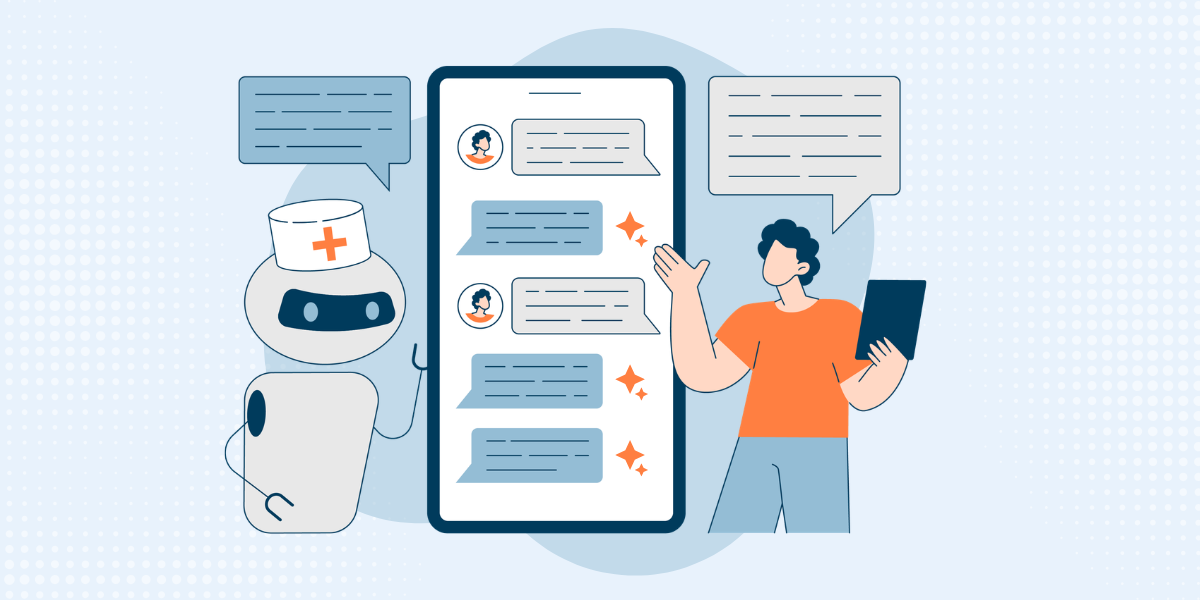
Patients are increasingly turning to generative AI tools for symptom checks and treatment research before they even step into a clinic. For healthcare providers, the arrival of the “AI-informed patient” requires navigating new clinical dynamics and adopting enterprise-grade, natively integrated AI solutions to restore efficiency and build patient trust.
Key takeaways
- Massive Patient Adoption: Approximately six in ten US adults report using AI tools for healthcare in the past three months, with over 40 million individuals using ChatGPT for health questions daily.
- Off-Hours Utilization: 70% of health-related conversations with AI occur outside of normal clinic hours, indicating these models serve as a decentralized digital triage.
- The Risk of Misinformation: Studies reveal that public generative AI models achieve only a 52.1% diagnostic accuracy rate and are highly susceptible to “hallucinating” false medical information.
- The Privacy Crisis: Over 40% of health AI users have uploaded sensitive personal medical information (like test results) into consumer chatbots that lack strict HIPAA compliance.
- The Provider Solution: Natively integrated ambient AI scribes, like RXNT’s Ambient IQ, can reduce documentation time by up to 70% and increase physician Relative Value Units (RVUs) by 5.8% without compromising care quality.
Why Are Patients Turning to AI for Health Advice?
Patients are integrating AI into every phase of their healthcare journey. Recent polling indicates that nearly one in three adults now turn to AI chatbots for health advice, a rate that equals the share of individuals who use social media for health information. The motivations driving this behavior include:
- Symptom Exploration and Triage: Patients use conversational AI to evaluate possible causes for their symptoms and determine urgency. Concerningly, about 21% of adults aged 18 to 29 report consulting AI for physical health advice and subsequently skipping a formal medical visit.
- Closing Geographic Access Gaps: AI is frequently used to overcome access barriers in “hospital deserts”—areas more than a 30-minute drive from a medical facility. In late 2025, patients in these underserved locations generated over 580,000 healthcare-related AI messages weekly.
- Treatment Research and Second Opinions: Patients leverage AI to compare surgical procedures, understand medication side effects, and even compile cited literature reviews to successfully appeal complex insurance denials.
- Health Literacy: AI tools excel at breaking down complex medical jargon into plain language, helping patients better understand their diagnoses and clinical protocols, which is a critical step in boosting long-term care adherence.
The Dark Side of Patient-Driven AI: Misinformation and Privacy Risks
While AI can foster more informed patient-provider discussions, relying on consumer-grade models introduces significant clinical and psychological hazards that practitioners must be prepared to address.
Medical Hallucinations and Inaccuracy
Public AI chatbots are auto-regressive; they predict the next logical word based on training data rather than retrieving verified facts. This architecture routinely leads to “artificial hallucinations,” where AI invents plausible but completely false medical details. A landmark 2025 study by Mount Sinai researchers demonstrated that when fictional medical terms were introduced into user prompts, AI chatbots confidently generated detailed, fabricated explanations and disease progressions instead of recognizing the error. With generative AI models achieving an overall diagnostic accuracy of just 52.1%, acting on this unverified advice can severely delay proper care pathways.
AI-Induced Cyberchondria
The unfiltered nature of AI-generated medical advice is fueling a rise in “cyberchondria”—excessive health-related internet research that escalates emotional distress. A recent study of adolescents found that 83% reported searching for health topics online, and cyberchondria showed strong positive correlations with general health anxiety, problematic internet use, and an intolerance for uncertainty. Because an AI chatbot cannot conduct a physical exam to rule out low-probability conditions, it routinely presents catastrophic diagnoses alongside benign ones, completely overwhelming the patient’s cognitive load.
The HIPAA Compliance Illusion: Data privacy represents a systemic vulnerability. More than 40% of users admit to uploading highly sensitive medical data, including lab results and clinicians’ notes, directly into public AI tools. Consumer versions of chatbots like ChatGPT and Gemini do not offer out-of-the-box HIPAA compliance, meaning patient data could theoretically be absorbed as raw training data for future public models or otherwise exposed.
Preparing Your Practice: The ROI of Natively Integrated AI Solutions
To manage the shift toward the AI-informed patient, providers must adopt secure, enterprise-grade AI technologies that restore the therapeutic alliance and alleviate burnout. As noted by the American Medical Association (AMA), AI should be utilized as “augmented intelligence“—enhancing, rather than replacing, the essential human element of clinical judgement.
The most effective clinical countermeasure is the implementation of Ambient AI scribes. Ambient technology passively and securely listens to the natural conversation between a physician and a patient, utilizing natural language processing to instantly translate the dialogue into a highly structured clinical note.
Recent empirical data proves the profound economic and operational ROI of this technology. A massive study conducted at UCSF analyzing nearly 1.2 million patient encounters found that physicians using AI scribes saw a 5.8% increase in generated Relative Value Units (RVUs) and were able to accommodate an average of 0.80 additional patient encounters per week.
The RXNT Advantage: Ambient IQ and Encounter Insights
Many health technology vendors offer fragmented, third-party AI plug-ins that merely bolt onto existing Electronic Health Record (EHR) systems. These disjointed architectures frequently create clunky workflows and dangerous data silos. To truly optimize a practice, leadership should seek natively integrated software ecosystems.
RXNT equips your practice to manage this shift seamlessly. Built on over 26 years of proprietary clinical insights, RXNT’s Ambient IQ is one of the industry’s few natively built ambient listening tools. Integrated directly within RXNT’s comprehensive EHR and Practice Management suite, Ambient IQ accurately documents critical details that might otherwise be overlooked, reducing documentation time by up to 70%.
Coupled with Encounter Insights—an AI-powered feature that automatically summarizes every signed encounter in a patient’s historical chart—providers are instantly presented with the most critical clinical data, dramatically speeding up visit preparation and accelerating revenue cycle coding. Furthermore, RXNT ensures absolute security; Ambient IQ is fully HIPAA-compliant, processing data within SOC-2 Type II certified data centers, and automatically deleting ephemeral patient audio once the encounter is safely transcribed.
The AI-informed patient is already here. Transform this challenge into an opportunity for more personalized care, improved clinical throughput, and a stronger bottom line. Empower your clinicians with the secure tools they need to succeed—experience the RXNT difference with a free demo today.