RXNT Named to TIME World's Top HealthTech Companies of 2026 for Second Consecutive Year
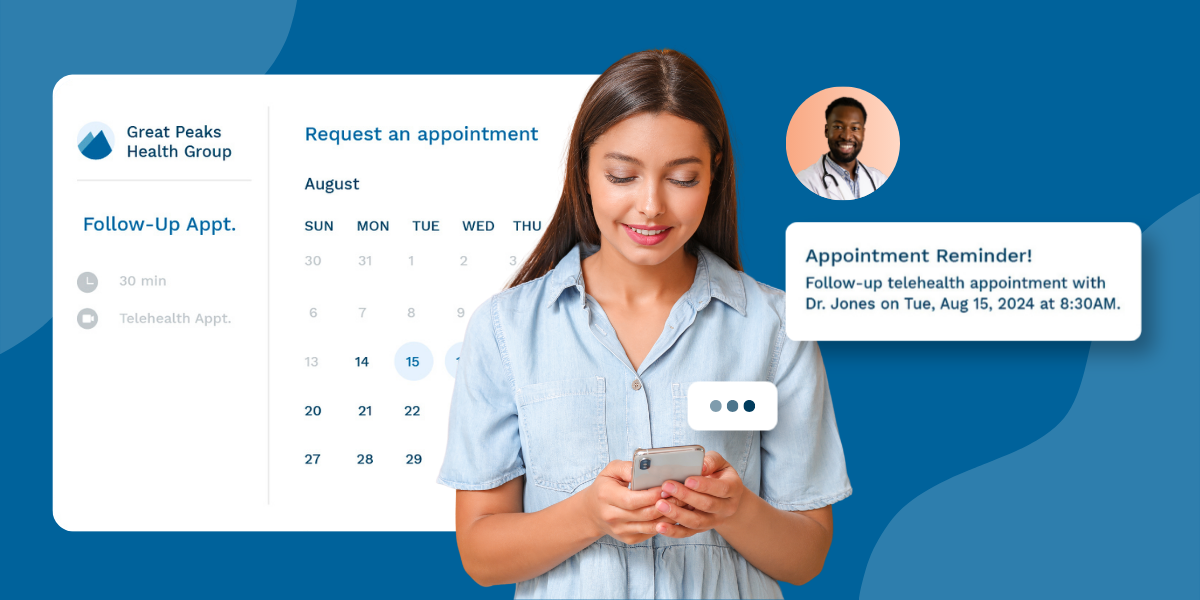
Appointment reminders, digital intake, self-scheduling, follow-up messages, medication reminders, and online payments can keep patients connected without requiring staff members to initiate every interaction manually.
Key takeaways
- Automation can strengthen patient engagement by making routine communication more timely and consistent.
- Digital convenience has become an important part of the patient experience. Online scheduling, portals, forms, messaging, and mobile access give patients more control over routine healthcare interactions.
- Automated appointment reminders can help reduce no-shows; research has consistently found that electronic reminders improve appointment attendance.
- Poorly designed automation with generic messages, excessive notifications, poor timing, and limited opportunities to reach a person can make communication feel transactional.
- Relevant information, appropriate timing, patient preferences, and clear next steps can make automated communication more useful.
- The best automation supports human interaction rather than replacing it.
- By handling predictable administrative touchpoints, technology can create more capacity for meaningful patient conversations.
There’s a communication problem in healthcare that’s not necessarily caused by a lack of communication per se. In many practices, the root of the problem is finding the right method and enough time to communicate with every patient at the right moment, through the right channel, and with information that is actually useful.
Patients increasingly interact with healthcare through digital channels. According to US government data, 65% of individuals nationwide accessed an online medical record or patient portal, more than double the percentage in 2014. More than three-quarters of people who used a patient portal in 2024 used it to message their providers, and a similar percentage used it to schedule appointments.
App-based access has risen sharply as well. At the same time, healthcare professionals are managing demanding clinical schedules, administrative responsibilities, documentation requirements, and growing volumes of patient messages.
Automation can help close that gap. Appointment reminders, digital intake, self-scheduling, follow-up messages, medication reminders, and online payments can keep patients connected without requiring staff members to initiate every interaction manually.
But there is an important distinction between automating communication and automating the patient relationship. Used thoughtfully, automation can make care feel more responsive and accessible while giving healthcare teams more time for the conversations that require a human connection.
Patient Expectations Have Changed Faster Than Practice Workflows
For decades, interacting with a medical practice usually meant making a telephone call. Scheduling an appointment, asking a question, requesting information, completing paperwork, or paying a bill typically required direct staff involvement.
This is a model that has become increasingly difficult to sustain. Patients have become accustomed to completing everyday tasks online when and where it is convenient for them. Healthcare is moving in the same direction.
Digital access does more than provide convenience; it can actually remove friction from the patient journey. A patient who remembers at 9 p.m. that they need to schedule a follow-up visit does not necessarily want to wait until the office opens the next morning. Likewise, someone who can complete intake forms before arriving may spend less of the appointment dealing with paperwork.
Practices, however, face a difficult balancing act. Meeting these expectations manually can create more phone calls, messages, repetitive tasks, and administrative work for teams that may already be stretched thin.
The question, then, is not simply whether practices should communicate more. It is how they can communicate more effectively without making every interaction dependent on additional staff time.
Automation Can Keep Patients From Falling Through the Cracks
Many patient engagement problems occur between visits.
A patient forgets an appointment. Another does not schedule the follow-up recommended by a provider. Someone misses a medication reminder or does not know what paperwork needs to be completed before arriving. A bill goes unpaid because the patient sets it aside and forgets about it.
Individually, these may seem like small breakdowns. Across hundreds or thousands of patients, however, they can create significant consequences for both patients and practices.
Missed appointments are a good example. A systematic review of 105 studies estimated an average no-show rate of approximately 23%, although rates varied substantially across populations and settings. No-shows can interrupt continuity of care while leaving unused appointment slots that could have been offered to other patients.
Automated reminders provide a relatively simple intervention. A meta-analysis of SMS reminders found that patients receiving them were more likely to attend appointments than patients who did not receive reminders. A more recent systematic review of behavioral interventions similarly found significant evidence supporting reminders delivered by SMS, telephone, or mail for reducing no-shows across multiple medical settings.
The larger lesson extends beyond appointment reminders: well-timed communication can prompt patients to take the next step before an overlooked task becomes a missed opportunity for care.
What Can Healthcare Practices Automate?
Effective patient engagement automation does not have to be complicated. In many cases, the greatest value comes from automating routine, predictable interactions that otherwise consume staff time.
Common opportunities include:
- Appointment reminders: Notify patients about upcoming visits and provide clear instructions for confirming, canceling, or rescheduling.
- Medication reminders: Prompt patients when it is time to complete medication-related tasks when appropriate.
- Follow-up communications: Remind patients about next steps after an appointment, procedure, test, or other care interaction.
- Digital forms and intake: Allow patients to complete registration information and other paperwork before arriving.
- Self-scheduling: Give patients the ability to book eligible appointments without waiting on hold or exchanging multiple messages with staff.
- Payments: Make it easier to receive statements and complete appropriate payments electronically.
Patient portals can bring several of these functions together. The American Medical Association (AMA) notes that portals can enable patients to arrange appointments, view test results, request prescription refills, communicate with clinicians, and access their medical records.
The objective is not automation for its own sake. Each automated process should remove a specific point of friction for the patient, the practice, or ideally both.
Where Patient Engagement Automation Goes Wrong
There is a paradox at the center of automated communication: sending more messages does not necessarily make a practice more communicative.
Patients quickly recognize communications that appear irrelevant or unnecessarily generic. If every message sounds exactly the same regardless of why a patient is receiving it, automation can make an interaction feel less personal rather than more convenient.
Frequency matters, too. Appointment confirmations, reminders, portal alerts, payment notifications, follow-up messages, and other communications can accumulate quickly. Without coordination, helpful reminders can become notification fatigue.
Timing can create similar problems. A message delivered when a patient cannot reasonably act on it is less useful than one that arrives when the next step is clear and accessible.
Perhaps most importantly, automated communication should not become a dead end. Patients will occasionally have questions or situations that do not fit into predefined workflows. A reminder that tells someone what to do but provides no practical path to ask for help can create frustration.
AHRQ recommends that patient communication systems make practices easy to reach and that portals include useful features such as secure messaging and appointment scheduling. It also recommends establishing procedures for determining who answers electronic messages and how quickly responses should occur.
In other words, successful automation needs an exit ramp to human assistance.
Personalization Is About Relevance, Not Just a Patient’s Name
Personalization is sometimes treated as a cosmetic feature: insert the patient’s first name into an otherwise generic message and call it “personalized.”
The truth is that meaningful personalization goes further than this.
A useful automated message reflects where the patient is in the care journey. An appointment reminder should contain information relevant to that appointment. A follow-up message should correspond to the next step the patient is expected to take. A payment notification should provide a straightforward way to review and address the balance.
Practices should also consider communication preferences where their technology and workflows allow. Not every patient wants to engage in the same way, and not every interaction is appropriate for the same communication channel.
This is where integrated technology can make a significant difference. When scheduling, patient engagement, clinical, and administrative workflows operate as part of a connected system, practices have more opportunities to trigger communications based on actual events rather than relying on disconnected processes.
RXNT’s patient engagement tools, for example, support capabilities including patient self-scheduling, contactless patient enrollment, online payments, secure messaging, forms, and access to information through its patient portal. These types of connected capabilities can help practices build engagement into everyday workflows rather than treating communication as a separate administrative task.
Better Automation Creates More Time for Human Connection
One of the strongest arguments for automation is also one of the most easily overlooked: technology can give people more time to be people.
Every routine task performed manually requires someone’s attention. A staff member making reminder calls is not helping the patient standing at the front desk. A nurse repeatedly tracking down administrative information has less time available for clinical questions. A provider navigating inefficient communication processes has less capacity for the conversations where reassurance, explanation, judgment, and empathy matter most.
Automation works best when practices distinguish between transactions and relationships.
Confirming that an appointment is Tuesday at 10 a.m. is primarily transactional. Discussing why a patient is worried about that appointment is relational. Sending a routine reminder about a follow-up is transactional. Helping a patient understand why the follow-up matters may require human interaction.
Technology should handle more of the former so healthcare professionals have greater capacity for the latter.
That principle is already being demonstrated at scale. The American Medical Association recently highlighted one health system where patients self-scheduled more than four million appointments in 2024 while automated registration saved care teams approximately 291,000 hours of work. The organization simultaneously emphasized that efficiency initiatives need to maintain or improve patient care.
The goal is not fewer interactions with patients. It is fewer unnecessary manual interactions competing with the conversations patients truly need.
Measure Engagement by What Becomes Easier
Practices implementing automation should look beyond the number of messages sent or workflows automated. A more useful question is whether those processes make it easier for patients to participate in their care.
Are more patients confirming or rescheduling instead of becoming no-shows? Are forms completed before appointments? Are patients receiving follow-up information consistently? Can they schedule eligible visits without calling the office? Are routine administrative questions being resolved faster? Are staff members spending less time on repetitive outreach?
These indicators connect automation to outcomes that matter operationally and experientially.
Practices should also pay attention to where automated workflows create friction. High message volumes, repeated patient questions, abandoned digital processes, or staff frequently overriding an automated system can signal that a workflow needs adjustment.
Automation should evolve along with patient needs and practice operations rather than becoming another rigid layer of technology.
The Most Personal Automation May Be the Kind Patients Barely Notice
Good healthcare automation should not call attention to itself. Patients should notice that they received the information they needed, that scheduling was straightforward, that they knew what to do before an appointment, and that reaching the practice did not require unnecessary effort.
They should also know that when their needs extend beyond a routine transaction, a person is still there.
That is ultimately how automation can improve patient engagement without making healthcare feel impersonal. The objective is not to replace conversations with technology; rather, it’s to use technology to handle predictable touchpoints consistently, giving healthcare teams more time and attention for interactions where human expertise and connection matter most.
An integrated approach to scheduling, patient communication, forms, payments, and clinical workflows can help practices strike that balance. RXNT offers connected medical software designed to simplify these processes while supporting a more accessible patient experience. Contact us to learn more about how thoughtfully designed automation can strengthen patient engagement while giving your team more time to focus on patient care.